Publications
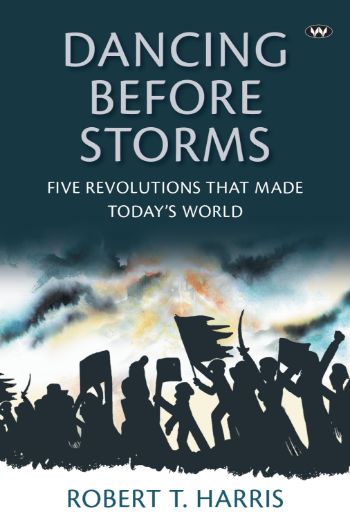
Dancing Before Storms
America 1776
France 1789
Europe 1848
China 1911
Russia 1917
These five revolutions shaped the power structures of our modern world. Each time, the elites of the day ignored the warning signs. Each time they continued ‘dancing before storms’.
Dancing Before Storms is about times of anger and upheaval, the connections between them, and the personal stories of men and women who had power and influence but were overtaken by events.
Is revolution brewing again? What can we learn from the violence of the past?
Book Launch Video – Ayers’ House, Adelaide 8 June 2022
Reviews
“Why is the writing on the wall before a revolution still ignored ? ”
Mark Thomas in The Canberra Times
“Dancing Before Storms is a splendid book, full of fascinating analysis and thought-provoking ideas.”
John West : World Geostrategic Insights, Rome ; Australian Institute of International Affairs, Canberra; Kootneeti, New Delhi; Asian Century Institute, Sydney, Tokyo, Toronto
“Dancing Before Storms is deliciously readable … it delivers page-after- page moments of clarity, moments of horror, and moments of fascination.”
Tracy Korsten, GLAMADELAIDE
“Fascinating and well written account of personalities behind the scenes…”
Guntars Catlaks on Facebook
“True to its invitation, get ready for an express ride though modern history!…The result is an impressive historical work … superior narrative … with insightful research ….”
Rama Gaind,PSNEWS
“Bob Harris has written a very readable and accessible book that recounts critical moments in history, it makes one reflect on … the times in which we are living.”
Jim Baker on LinkedIn
“Dancing Before Storms is thought provoking […] A brave and courageous work, the book summarises the events of five major revolutions in history”
Christina Ealing-Godbold, on Professional Historians Australia website
Read the full reviews below :
Mark Thomas

Dancing Before Storms by Robert T. Harris review – Why is the writing on the wall before a revolution still ignored?

A Kodachrome slide of a Soviet October Revolution celebration in 1983, 66 years after the revolution. Picture by Thomas Hedden
The Book of Ecclesiastes might be amended just a tad. Of the making of history, rather than books, there is no end. Not only is there perpetual debate over which facts actually count and which version of the story is accurate, the perspective, the historical angle of view, is also endlessly fluid.
Take three recent, consistently excellent examples of history writing. An hour-by-hour account of one critical day during a revolution can provide compelling insight into motives, emotions and intentions. An attempt at autobiography, transmuted into an account of a nation’s travails during the author’s lifetime, can enliven and enlighten any reader. The chronicle of a dictator’s accession to power can be re-written, part as diary, part as novel, part as historical record.
Those three books are The Fall of Robespierre by Colin Jones, Fintan O’Toole’s We Don’t Know Ourselves and M by Antonio Scurati. All open up for readers a new window on how to understand and calibrate the past. General histories can try to do the same, if their authors resist assiduously any temptation to over-generalise and over-simplify. That task is still more difficult when the subject matter is already well-known and readers may well have taken sides.
Robert T. Harris perseveres. Not the distinguished novelist of the same name but instead an expert on civil society and non-government organisations, Harris addresses “five revolutions that made today’s world”. He duly works his way through the American and French revolutions, the half-baked “revolutions” of 1848, then China’s and Russia’s revolutions. Hitler’s Germany, among the most comprehensive revolutions, albeit one which lasted only twelve years, does not make the cut. Harris is finally drawn to another question, about the future rather than the past: “Are the conditions ripe for a new earth-shattering revolution?”
Harris’ title is a little odd. Dancing on the edge of a precipice, or dancing on hot coals, are more customary metaphors for carrying blithely on, enjoying yourself, as political institutions, social tranquillity and economic stability all collapse. Pissing in the wind might be a more vulgar synonym.
Harris wants to explain why “if ignoring the writing on the wall makes no rational sense, why does it still happen?” One answer, classically Marx’s, would be that the ruling class has exhausted its prospects by ignorance, greed, venality or myopia. Another option, one preferred by many historians, claims that the most dangerous moment for pre-revolutionary regimes arrives when they decide to reform.
A third slides into the realm of contingency and conjecture. What if Danton had displayed less audacity but more cunning, if Stolypin had not been shot at the Kyiv opera, if Kang You Wei’s liver had not packed up, or if the British had been less brutishly, blindly selfish in approaches to their American colonies? Bearing the Iranian revolution of 1979 in mind, a fourth possibility might be that at least some revolutions cannot be sufficiently foreseen and forestalled.
Along the way Harris allows a few flat patches and banalities to intrude. “The industrial revolution was not something that happened overnight.” Or, “the main idea of the [Communist] manifesto was that of class struggle”. “George III saw the war as a conflict between him and [Benjamin] Franklin”. Of the 9/11 terrorist attacks, Harris remarks: “the psychological impact on the United States was dramatic”.
The narrative is lifted by Harris’ decision to focus on individuals, telling the life stories of key figures in each of the revolutions. He begins with Franklin, oddly designated as “this most British of Americans”, a man who supposedly “personified the times”. More intimately and more humorously, Harris notes that Franklin was so proficient at laps in the Thames that he thought of abandoning public life to become a swimming coach.
On the stories go, often with a dose of suspense and a whiff of romance to sustain the reader’s interest. For admirers of Bridgerton, Harris finds room for a review of etiquette during the season of Georgian London. In another interlude, he digresses to muse about whether Lenin had a child with his lover. Unexpectedly, he concludes his run of stories with Kofi Annan, obliged to “confront the complexity of the issues facing a global community of nations”.
Harris’s analysis is certainly up to date. His last section deals with Black Lives Matter and the January 6, 2021 riots in Washington as well as with COVID. Turning to the modern world, Harris examines “the heaving, distorted pyramid” of inequality, perceptions of injustice, denial of aspirations, scandals and the impact of wars. That is, he seeks out modern analogues for the forces which provoked the revolutions he has already assessed. Harris’ conclusion is quite bleak: “business as usual is the riskiest option”. No dancing before storms is one of his remedies.
Reviewed by Mark Thomas
Prof John West



DANCING BEFORE STORMS: FIVE REVOLUTIONS THAT CHANGED THE WORLD Five political revolutions, from the American revolution to the Russian revolution, offer lessons on how to manage the forces of political, economic and social change, according to Robert T. Harris. This review has been published by:
•World Geostrategic Insights, Rome
•Australian Institute of International Affairs, Canberra
•“Kootneeti”, Sustainable Development Goals, New Delhi
•Asian Century Institute, Sydney, Tokyo, Toronto
John Lennon of the Beatles once sang “You say you want a revolution. Well, you know, We all want to change the world”. And in a new book, Robert T. Harris, a wellknown spokesperson for civil society and the trade union movement, argues that today the world is indeed primed for a new revolution, or revolutions, that will upset the existing order.
In his book, “Dancing Before Storms: Five revolutions that Changed the World”, Harris analyses the American and French revolutions of the late eighteenth century, then the revolutions that swept across Europe in the mid-nineteenth century, and the Chinese and Russian revolutions of the early twentieth century. It is an engrossing express ride through modern history, spanning roughly 150 years. But it is a ride that provides important insights for the world of today.
As Harris argues, “History never precisely repeats itself, and history does not predict the future. Nevertheless, history provides lessons which may inform the present.” For example, the story of five revolutions shows how growing inequality and the dashing of aspirations for the majority of people, combined with serial scandals, created preconditions for revolution. Thus, Harris quotes Harvard philosopher George Santayana – “Those who cannot remember the past are condemned to repeat it.” Much ink has been spilt over the years analysing these five revolutions. But Harris’ narrative may be unique in that it sees parallels and linkages between the five revolutions, which are typically analysed in isolation. Moreover, he focuses on the influence of five individuals – one for each revolution – who were active participants in the political struggles of their times.
Harris argues that Benjamin Franklin, Jacques Necker, Alphonse de Lamartine, Kang You Wei, and Pyotr Stolypin each exercised their considerable powers to try to change the course of events, but failed to prevent the storms of revolution. Entrenched elites were tragically “dancing before storms”. In other words, none of these revolutions were inevitable. With much greater wisdom from political leaders they could have been prevented. Harris argues that the road to peaceful change is paved with obstacles – “Overcoming vested interests and the natural propensity of people to deny the writing on the wall can make the task of rational reform extraordinarily difficult”. Harris argues that these five revolutions set the scene for the dramatic changes and conflicts of the next 100 years. Indeed, the past century may have been the most tumultuous in human history.
World Wars. Great Depression. Discoveries of nuclear fission and fusion. Decolonisation in Africa, Asia and Latin America. The division of Europe by an iron curtain. The Cold War, followed by the collapse of the Soviet Union. Creation and expansion of the European Union. Genocides. Long drawn-out wars in Africa, Asia and the Middle East. Global supply chains. Financial crises. Advent of the Internet. And this hectic history has only continued into the 21st century, with a global financial crisis, the urgent challenge of climate change, great power competition between the US and China, the reemergence of Russia as a rogue state, the presidency of Donald Trump, Brexit, the riotous invasion of the Capitol Building in Washington, and COVID-19.
In discussing the new millennium, Harris introduces us to a sixth key personality, the Nobel prize-winning Secretary-General of the United Nations, Kofi Annan, who brought a spirit of hope to the world at the dawn of the new millennium. But this hope was sadly extinguished by the 9/11 terrorist attacks of 2001 and the 2008/9 global financial crisis. Harris proposes four lessons from his examination of these revolutions. First, “when imbalances develop in a society – at any level, local, national, or global – a point will be reached when that society will become unstable”. Second, “no one can predict when and how a tipping point will occur. In each of the revolutions described, conditions had been building for decades”. A quotation attributed to Aristotle in the time of the ancient Greeks states: ‘Revolutions are not about trifles, but spring from trifles.’ Third, “not every uprising becomes a fully-fledged revolution straight away”. Fourth, “When revolutions became more than uprisings, when the structures of societies were overturned, the consequences were rarely predictable, but always far-reaching”. The American revolutionaries could hardly have imagined the civil war of epic proportions in the nineteenth century.
Harris argues the key underlying lesson from these five revolutions is that human beings have a great capacity for denial. In each of the stories of the five revolutions, the elites of the day refused to admit the prospect that their privileges and lifestyles could be swept away by the storms of revolution. Much of his narrative is about denial, even in the face of ample warnings, and despite the efforts of people who were for a time in positions of great power and influence. Harris concludes that all the signs for revolution are present today – rising inequality, elite corruption, burgeoning climate change, social unrest, anti-migration sentiments and xenophobia, a growing sense of injustice within many societies, and declining trust in political processes and institutions. And he argues that Covid-19 has significantly increased the odds that earth shaking upheavals are still to come.
Like virtually every publication, Harris’ new book already needs updating, even though it has only just been published. If he were writing today, he may have included as further warnings of possible revolutions things like Russia’s invasion of Ukraine and the unrest in Shanghai as President Xi Jinping buckles down in his attempt to eliminate COVID-19 in China. If there is one shortcoming in Harris’ book, it is that he does not concede that revolutions can at times be effective and unavoidably necessary ways to bring about political and social change. Further, he does not speculate as to where, how and in what form a future revolution might take place. In his defence, however, such speculations are immensely difficult to undertake with any rigour.
Overall, “Dancing Before Storms” is a splendid book, full of fascinating analysis and thought-provoking ideas. It is a poignant reminder that “black swan” events are all too frequent through history, and that political myopia and complacency are perhaps the greatest enemies that comfortably prosperous Western countries must contend with.
Reviewed by Professor John West
Tracey Korsten

Dancing Before Storms looks at five seminal revolutionary movements of the modern world: the American Revolution, the French Revolution, the 1848 European revolutions, the Chinese Revolution, and the Russian Revolution.
Harris works an interesting thread through these five periods: the elite and ruling classes were given warning that revolution was in the air, but simply continued to “dance before the storm”, in some cases, quite literally! What he also does is weave together certain personalities, demonstrating how these movements, and particularly the French, American, and 1848 revolutions talked to each other, both in terms of underlying philosophy, and of actual people. Amongst this fascinating parade are such characters as Benjamin Franklin, Jacques Necker, Germaine de Staël, Vladimir Ulyanov (Lenin), and Sun Yat Sen. Harris’s research around these connections is meticulous. The five main sections form a whole, segueing from one movement to another, from the Storming of the Bastille to the rise of Stalin.
In a final section, Harris looks at the world today, drawing out the lessons of the past 250 years. Who today is dancing before the storm? And what storm? We witness the rise of Kofi Annan, the revival of the debutante ball in London, and the gilets jaunes movement in France. At the time of his writing, Covid had just hit, so Harris is also able to look at the effects of a global pandemic, shutdowns, and (possibly too soon) re-openings. He also briefly considers the Black Lives Matter movement and the shenanigans around the recent US election.
Dancing Before Storms is deliciously readable. Learned, serious, and fact-heavy, it delivers page-after-page of moments: moments of clarity, moments of horror, and moments of fascination. It perhaps tries to do too much, especially in the final chapter, which is jam-packed but much more pedestrian than the substantive content of the previous chapters.
As well as thorough notes, Harris includes a list of all the people he mentions, grouped by the chapters in which they first appear.
This is a huge work, and one for which Harris deserves admiration. Most importantly, this is a book which captures the reader, and keeps them there throughout some of the darkest periods of recent human history.
Reviewed by Tracey Korsten
Guntars Catlaks
Just finished reading the book Dancing Before Storms, by Robert Harris. One could ask, what new or more you could possibly say about the last 300 years of our history, including American, FrEnch, Chinese and Russian revolutions, yet you can.
Kudos Bob Harris! Fascinating and well written account of personalities behind the scenes, who aspired, tried and failed to change the course of events, which shaped the world as we know it. For better or worse? My only afterthought – are we still dancing….
Reviewed by Guntars Catlaks on Facebook
Rama Gaind

True to its invitation, get ready for an express ride through modern history!
As well-known commentator on education and public policy, Robert T. Harris explains the story of five revolutions that shaped the modern world grew out of a simple question. Why do people in power and those who surround them so often ignore the signs of impending catastrophe? Hence the title ― Dancing Before Storms ― is both an assertion and a question.
The result is an impressive historical work of comprehensive motivation.
The groundbreaking revolutionary movements were: the 1776 American Revolution, the 1789 French Revolution, the 1848 European Revolution, the Chinese Revolution in 1911 and the Russian Revolution of 1917.
Harris works on a thought-provoking strand through these five periods: there were warning signs for the exclusive and reigning classes about a revolution being in the air, but they merely continued to “dance before the storm”.
These rebellions shaped the power structures of our modern world. Each time, the elites of the day ignored the warning signs. These main sections align to become a whole, transitioning from one movement to another, like Storming of the Bastille and the rise of Stalin.
Dancing Before Storms is about times of fury and turmoil, the links between them and the personal stories of men and women who had power and influence, but were overtaken by events.
While these revolts offer lessons on how to manage the forces of political, economic and social change, Robert T. Harris argues the human propensity for denial means that we are likely heading toward new revolutions.
There’s no doubt this is an ambitious gambit, but this superior narrative achieves that with insightful research and focus on historical personalities and concealed connections. It’s a captivating parade of characters including Germaine de Staël, Sun Yat Sen, Jacques Necker and Benjamin Franklin.
Reviewed by Rama Gaind
Jim Baker
Bob Harris has written a very readable and accessible book that recounts critical moments in history. It makes one reflect on how the times in which we are living relate to those historical settings that led to revolutions and, so often, made them fail. That is one of the missions of the book – to illustrate the present with the past.
“Dancing before Storms” is not a dry, academic recounting of facts nor is it intended to be. It is an easy and quick read, but, nevertheless, carries lessons of history and leaves behind thoughtful and stimulating traces. The final section weaves together the five revolutions and the weaknesses of reform movements, often democratic in inspiration, that preceded them into a picture that helps to understand the present. It was written before the Russian invasion of Ukraine, however, that brutal revival of imperialism spearheaded by an out-of-touch autocrat would fit well into the narrative.
Taking history seriously
Rather than repeat the linkages between the past and the present, I encourage those who read these observations to read the version originale. The book prompted a few additional thoughts.
History shapes our lives
One is that our history is part of our DNA even if we do not know it. In fact, it may have more grip on our behaviour if we are ignorant of history than if we try to fathom it. Understanding, reflecting, and being critical is a part of democracy that is sadly lacking in many countries. Perceiving the forces of history, its disputes, and the weakness of leaders gives one the necessary bit of distance to question certainty and rigidity and to seek agreement.
The arrogance of power
The thrust of Senator J. Willian Fulbright’s book of the same name was opposition to the Vietnam War, but it also spoke of a larger problem with arrogance of a nation, his nation, in its relations with others. “Dancing before storms” gives examples of arrogance of nations, but also of individuals whether it is royalty, reformers, or dictators who emerge from revolutions.
Historically, arrogance of rulers profoundly offends those who are not part of the elite. In that context, it is remarkable that President Trump, the king of arrogance, can mobilise people against the elites and, “deliver” for them with massive tax cuts for those very elites.
Such monumental arrogance combined with aggressiveness should block manipulation of even his supporters. But it does not seem to matter to the true believers. Of course, the cult of the personality has been part of the myth and power of other unpleasant people like Hitler and Stalin.
Inequality and revolution
The growth of inequality and injustice since the Reagan-Thatcher days, which made a quantum leap in the financial crisis in 2008-2009 has weakened democracy considerably. The book makes it clear that it is nothing new and was a factor in the five revolutions discussed. The pandemic did not help, but rather amplified inequality.
It is inequality and injustice that is felt by many, but with little hope that there is a way out. That cynicism weakens governments and, more importantly, the public will to make change. That is fertile ground for populist extremists. It is ground that is carefully prepared. It dovetails with a rosy vision of a past that never was instead of looking to and planning for the future. No ideas are offered, but only calls to throw out or attack others, up to and including through insurrection.
Sado-populism
American historian Timothy Snyder (author of “On Tyranny” and “The road to unfreedom”) describes this phenomenon as “sado-populism”. It is the art of mobilising people against moneyed and powerful elites and then pulling a bait and switch and re-directing anger to other powerless people.
People may be powerless, but they often do not feel that they can do anything about the powerful – everything is rigged against them. However, they can get some satisfaction and status by inflicting pain on others who, otherwise, might be their allies. It might be people of another ethnicity or race, religion, immigrants, caste, sexual orientation, or any of many other differences. If may produce and fan hatred or even violence, but it never generates justice or progress.
The way out – hope, not despair
Another lesson of history is that people have been able to come together in trade unions, in political parties and in other civic and civil organisations without depending on political leaders or authoritarians. What makes the current situation more urgent than the previous times is global warming on top of the economic and social crises. It adds a fear that the sands in the hourglass are running out.
In our current climate, progress requires over-coming massive dis-information and providing alternatives that are both sensible and inspiring. Isolation and polarisation is not just a political development. It is happening in our communities, in our neighbourhoods, and in our families. The struggle to correct our course will require listening to and discussing with others and re-learning how to agree, at least on some fundamentals. At the end of his book, Bob Harris states clearly what we are facing:
The challenge before all is to recognize the risk of inaction. Ways must be found for people to embark on the enterprise of forging new layers of consensus and trust in their societies -locally nationally and globally – about what is required to guarantee survival with decency and justice. Against the drumbeats of revolution and war must be opposed the simple human desire for peace and happiness.
Reviewed by Jim Baker on LinkedIn
Christina Ealing-Godbold
Dancing Before Storms is thought provoking. It recounts the expression of discontent in the revolutions of the 18th and 19th centuries, as well as that of our current century, which again highlights widening gaps in equity and equality. Whether the current malaise will result in political revolution is yet to become clear; attempts to predict it based on the features of another time in history are fraught with difficulty.
In Dancing Before Storms, Robert Harris has chosen an unusual way to analyse today’s society and its power structures. A brave and courageous work, the book summarises the events of five major revolutions in history, from the American Revolution of 1776 to France in 1789, Europe in 1848, China in 1911, and the Russian Revolution of 1917.
While much has been written on each of these revolutions by specialised scholars, the point of this study is to understand the connections and common trends between the revolutions, as well as the effect of these events on 21st-century society and its structures. Using the biography of an individual from each of the five revolutions, including Benjamin Franklin, Harris has distilled an understanding of the anger within society that led to each of these historical events. (He includes a useful appendix simply entitled ‘The People’ to list key historical figures of each revolution.) One could argue that these revolutions alone did not change society; in my opinion, other events, such as two world wars, the Great Depression and the use of nuclear armaments, were more active catalysts in the evolution of modern society. Still, there is credence in the view that the revolutions were influential.
Each revolution had a unique set of events that prompted civil unrest but Harris does effectively demonstrate that the same underlying trends and forces existed behind each one, the primary common factor being that the populace was not only aggrieved but also ignored by the ruling power structures. Harris warns that we ignore such trends of grievance and unhappiness at our peril.
When looking at our current century, there are many elements of widening gulfs of power, both political and economic. The author chooses some clear examples of inequality and swelling tides of disenchantment – the Black Lives Matter movement, the Donald Trump mantra of the stolen election, and climate change inertia on the part of governments are just a few examples. People are protesting about all these issues and, with the assistance of the media, both mainstream and social, they have become more discussed and analysed than perhaps ever before. Will the grievances result in revolutions similar to those of earlier eras? While such discontent will lead to change and evolution of some kind, I am not convinced, as Harris is, that this will be in the style of the revolutions that materialised between 1776 and 1917.
Those revolutions were particular to an era in history, which, from around 1760, saw another revolution. Harris notes that the Industrial Revolution ‘altered the course of human affairs … with the unleashing of new technologies came dramatic expansion of trade across the oceans’ and, with this, growing prosperity for some segments of society, as well as altered roles and occupations for the working classes. He also makes an interesting observation about the influence of rising literacy and reading on the spread of radical ideas: ‘[N]ew thinking about the nature of power and governance was emerging. New ideas were debated, published and read by an increasingly literate population’.
In the 21st century, ideas and thinking are now spread by another new, even quicker, more instantaneous, and often emotive method – social media. What this heralds is not yet clear, especially given, as Harris observes, ‘Revolutions do not follow rational paths’.